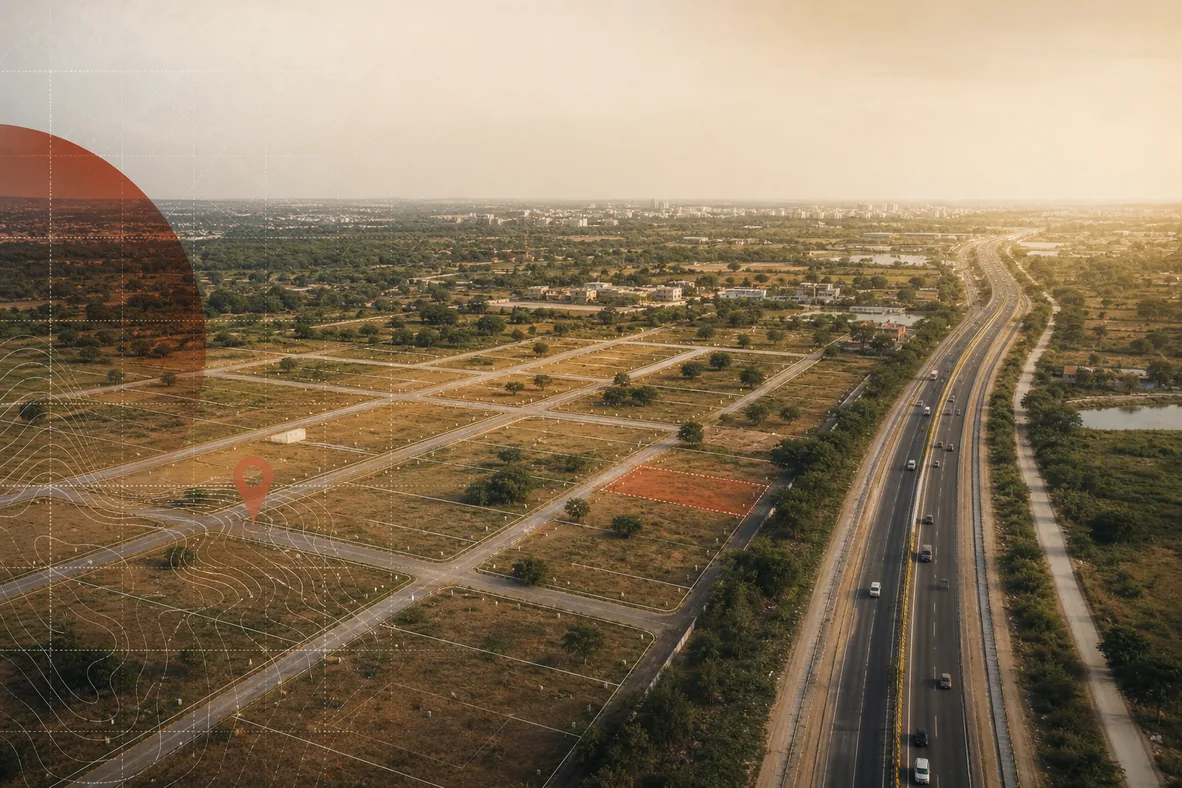
In 2016, Sangareddy was reorganized as a standalone district headquarters - carved out of the old Medak district. That administrative change, which barely made it to page four of the business press, has quietly become one of the most consequential real estate events on Hyderabad’s periphery this decade.
District headquarters are not just administrative labels. They are investment magnets. A Collector’s office means courts, government departments, legal services, banking branches, and the entire ecosystem of civic infrastructure that follows official designation. Every IAS officer posted to Sangareddy, every court lawyer setting up practice, every bank opening a branch for regulatory compliance - they all need housing, commercial space, and eventually, land. That demand compounds quietly, year after year, in ways that the more glamorous IT corridor narratives tend to miss.
Sangareddy real estate growth in 2026 is the product of at least five distinct forces operating simultaneously. Understanding each one explains why the price trajectory looks the way it does - and what comes next.
From Taluk to District: The Infrastructure Multiplier
Before 2016, Sangareddy was a taluk under Medak district. Most government functions of consequence happened in Medak town or in Hyderabad. Sangareddy had a sub-divisional office, some municipal infrastructure, and the kind of limited administrative presence that keeps land prices range-bound.
The district bifurcation changed this structurally. A new district headquarters requires:
- A fully functional Collector’s office and attached departments
- District and sessions courts
- District-level offices for health, agriculture, revenue, police, and welfare
- Expanded civic utilities - water supply, electricity distribution, roads
- Educational and healthcare infrastructure commensurate with district status
The investment in all of this - both by the state government and by private sector players following government money - has been ongoing since 2016 and continues today. Sangareddy now has a functional infrastructure base that did not exist a decade ago. This is the bedrock on which all other growth drivers are building.
IIT Hyderabad: The Demand Engine at Kandi
IIT Hyderabad’s campus at Kandi is approximately 45 km from Hyderabad and sits squarely within the Sangareddy district catchment. The institution has 576 acres, 200+ faculty, and over 5,000 students and researchers - and it has been growing consistently since its establishment.
What IIT Hyderabad does to surrounding land markets is a well-studied phenomenon at this point. The Bengaluru analogy is instructive: IISc’s presence in Malleswaram was a slow-burn catalyst that took decades to fully express itself in the surrounding real estate, but the directional impact was never in doubt. IIT Hyderabad is following a similar arc, but with a compressed timeline because the surrounding infrastructure - NH-65, ORR, industrial belt - was already in place.
The demand IIT Hyderabad creates for Sangareddy-area residential land comes from multiple sources:
Faculty housing demand: IIT faculty typically want to own residential property near their institution. Campus housing is limited; private plotted development within 10-15 km of campus captures this demand directly.
Research ecosystem attraction: As IIT Hyderabad’s research output grows, companies set up labs and incubation facilities nearby. These bring mid-to-senior professionals who want residential ownership rather than rental accommodation.
Student alumni retention: Over time, IIT alumni who start ventures or join nearby companies create a residential demand cluster. This is a 10-15 year lag effect, but it is already beginning to show up in Kandi area transactions.
Sustained rental and hostel demand: For investors who build on their plots, the IIT proximity creates a guaranteed rental demand base that pure agricultural belts do not offer.
For a detailed analysis of the IIT Hyderabad land price effect specifically, our open plots near IIT Kandi guide covers the micro-market data.
Supply-Demand Imbalance: The Hidden Story
The most underappreciated driver of Sangareddy real estate growth is the supply side - or more precisely, the lack of it.
HMDA-proposed and approved plotted layouts near Sangareddy are relatively scarce compared to raw demand. The HMDA planning process is rigorous: it requires clear title documentation, proper layout planning, infrastructure provision commitments, and regulatory processing that takes time. Many landowners in the belt have agricultural patta land that cannot be sold as investment-grade residential plots without going through this process.
This means that while the demand from IIT faculty, industrial workers, institutional investors, and Hyderabad city spillover buyers is growing, the supply of bank-eligible, clear-title, construction-ready plotted layouts remains constrained. The result is a supply-demand gap that keeps pushing prices upward - not driven by speculation, but by actual scarcity of investment-grade product.
The implication for investors: when you find an HMDA-proposed layout with immediate registration availability in the Sangareddy belt, you are looking at a relatively rare asset in a market where such assets are being absorbed faster than new supply can be created.
The Mobility Valley Effect: 100,000 Jobs on the NH-65 Belt
The Patancheru-Sangareddy belt on NH-65 has been targeted for Mobility Valley - a state-backed EV and auto-tech manufacturing cluster. The existing industrial base in this corridor (Patancheru APIIC area, auto ancillary units, chemical manufacturing) provides the infrastructure foundation. The Mobility Valley vision layers EV assembly, battery manufacturing, and mobility tech supply chain on top of this base.
The 100,000+ projected jobs are not expected overnight. But the trajectory matters for real estate: as anchor investments are committed and the job creation begins, the residential demand radius expands outward. At 30,000 jobs, you see prices move in Patancheru. At 60,000 jobs, you see prices move in Kandi. At 100,000 jobs - spread over a 10-year horizon - Sangareddy’s immediate periphery becomes part of the functional employment catchment.
Investors who enter the Sangareddy land market in 2026 are effectively buying ahead of the demand wave. That is precisely how the highest-multiple land investments work: you own the land before the institutional demand shows up, not after.
RRR: The Connectivity Multiplier Still Ahead
The Regional Ring Road’s Sangareddy node deserves its own analysis, because its impact on Sangareddy real estate will be unlike anything the district has seen in its short history.
The ORR created a new residential and commercial belt roughly 25-40 km from Hyderabad’s core. Every zone on the ORR that had industrial or educational anchors saw massive appreciation: Shameerpet, Kompally, Shamshabad, Hayathnagar. The pattern was consistent - ORR connectivity, plus a demand driver, plus time, equals multi-fold appreciation.
The RRR replicates this pattern at a wider radius. As a 340 km orbital highway with 100-meter right of way, it is designed to handle freight and industrial traffic that bypasses Hyderabad entirely. Sangareddy on the western alignment gains direct connectivity to the south and east of the ring - meaning the journey from Sangareddy to, say, the pharma city zone in south Hyderabad no longer requires navigating through the city. For industrial workers, logistics companies, and businesses needing multi-directional access, this is transformational.
The land acquisition and construction timeline for RRR is the key variable. Progress has been uneven. But the alignment is set, Sangareddy’s node position is confirmed, and the directional impact on land values is not in doubt. Our broader infrastructure and plot appreciation analysis covers how these orbital road catalysts have historically moved prices.
Addressing the “Too Far” Objection Head-On
Any honest analysis of Sangareddy real estate must address the distance question directly. Sangareddy is approximately 55 km from Hyderabad’s Financial District via NH-65. In peak traffic, this is a 75-90 minute commute. For daily office commuters working in Gachibowli or Hitec City, Sangareddy is not a practical primary residence choice - and we should not pretend otherwise.
But the investor profile for Sangareddy plotted land is not primarily the daily Gachibowli commuter. The buyer profile that drives this market is:
Appreciation-focused investor: Buys land, holds for 5-8 years, sells when RRR/Mobility Valley catalysts have fully priced in. Commute irrelevant.
NRI investor: Buying a tangible India asset in a growing market with bank loan support and clear title. No commute at all.
Industrial belt worker: Employed in Patancheru, Kandi, or Sangareddy itself. The “far from Hyderabad” problem does not apply when your workplace is on the same corridor.
Second home / retirement buyer: Looking for larger plots, cleaner environment, and lower density than Hyderabad’s inner suburbs. The distance is a feature, not a bug.
Sangareddy-area resident: Buying in their own district, which now has its own civic infrastructure. These buyers are not commuting to Hyderabad at all.
The commute question matters for inner-ring residential projects targeting daily workers. For plotted investment in an emerging corridor, the relevant question is whether the land appreciates - and on that count, Sangareddy’s fundamentals speak for themselves.
Price Trajectory: Where Sangareddy Land Values Are Heading
The 2020-to-2026 price data gives us the baseline: Rs 5,000-8,000 per sq.yd in 2020 to Rs 18,000-28,000 today in the Sangareddy periphery. That is a 200-260% appreciation over six years.
The next phase of appreciation will be driven by a different mix of catalysts - not just district HQ formation and IIT demand, but confirmed RRR infrastructure, Mobility Valley job growth, and HMDA layout supply normalization. Based on comparable corridor patterns (ORR East 2010-2020, Kompally 2012-2022), we project the Sangareddy periphery belt reaching Rs 40,000-55,000 per sq.yd in the 2028-2030 window if catalyst delivery stays roughly on track.
That projection is not guaranteed - infrastructure timelines in India carry real execution risk, and investors should factor that in. But even at a more conservative 100% appreciation from current levels, Sangareddy land at Rs 25,999 per sq.yd today reaches Rs 52,000 by 2030. For an investment backed by an 85% bank loan, the equity return on that appreciation is many times the capital deployed.
Our complete analysis of Sangareddy plot prices in 2026 breaks down micro-market pricing and recent transaction trends in detail.
GITAM University: The Second Knowledge Economy Anchor
Alongside IIT Hyderabad, GITAM University has an established presence in the Sangareddy-Hyderabad belt. GITAM is a private deemed university with strong engineering, business, and health sciences programs - and its student and faculty base adds to the residential and commercial demand in the corridor.
The combination of IIT Hyderabad (national prestige, research output, startup ecosystem) and GITAM (larger student enrollment, professional programs, alumni network) creates a knowledge economy cluster that is rare in Hyderabad’s periurban belt. Knowledge economy clusters consistently outperform pure industrial zones in long-run real estate appreciation - because the employment they attract tends to be higher-income, and the residents they retain tend to invest in residential ownership.
What Serious Buyers Are Doing Right Now
The investors we work with at Millennial Asset Realty who are active in Sangareddy are not waiting for the catalysts to fully confirm. By the time RRR construction progress is announced, or a major Mobility Valley anchor tenant signs on, the price response will happen faster than individual investors can react. The pattern is consistent across every growth corridor in India: prices reflect expected future value, not current utility. The investors who benefit are those who read the signals before they become headlines.
Vasantha Vihar Enclave in Sangareddy represents exactly this thesis - an HMDA-proposed layout priced at Rs 25,999 per sq.yd with immediate registration, 85% bank loan eligibility, and 2.4 km proximity to NH-65. The infrastructure pipeline analysis above explains why we expect significant appreciation from this base.
For investors working through the practicalities of buying plots in this market - what documents to check, how the registration process works, what to verify before committing - our step-by-step guide to buying HMDA plots in Hyderabad covers the full process.
The Sangareddy Growth Story, in Summary
Sangareddy’s real estate growth in 2026 is not a speculative bubble driven by developer marketing. It is the product of measurable, documented fundamentals:
- District headquarters formation (2016) with compounding civic infrastructure investment
- IIT Hyderabad at Kandi creating sustained multi-segment residential demand
- NH-65 industrial corridor (Patancheru pharma, auto ancillary) providing employment base
- Proposed Mobility Valley EV hub targeting 100,000+ jobs
- RRR western node confirming orbital connectivity ahead
- HMDA-proposed layout scarcity relative to growing institutional demand
- GITAM University adding knowledge economy depth
Each of these drivers is independently verifiable. Together, they create a price appreciation case that is structural rather than speculative - and that is precisely the type of market where thoughtful investors build long-run wealth.
Book a free site visit - advisor calls within 15 minutes ->
Millennial Asset Realty . Sangareddy . NH-65 . HMDA Proposed Plots . millennialassetrealty.com
Frequently Asked Questions
Why are property prices rising in Sangareddy in 2026
Sangareddy prices are rising due to its 2016 district headquarters upgrade, IIT Hyderabad at nearby Kandi creating sustained housing demand, proposed RRR orbital road alignment, Mobility Valley EV jobs projection of 100,000+, and limited HMDA-proposed plot supply relative to growing institutional demand.
What is the current price range for plots in Sangareddy in 2026
In 2026, plotted land in the Sangareddy outskirts and NH-65 micro-belt ranges from Rs 18,000-28,000 per sq.yd in peripheral zones to Rs 35,000-55,000 in the town core. HMDA-proposed layouts like Vasantha Vihar Enclave start at Rs 25,999/sq.yd.
How far is Sangareddy from Hyderabad and what is the commute like
Sangareddy is approximately 55 km from Hyderabad's Financial District. Via NH-65, the drive takes 60-75 minutes under normal conditions. The proposed RRR orbital road, with Sangareddy as a western node, will significantly improve multi-directional connectivity beyond just city-centre commute.
Is Sangareddy an HMDA jurisdiction
Yes. Sangareddy falls within the Hyderabad Metropolitan Development Authority (HMDA) planning area. HMDA-proposed layout approval provides legal clarity, bank loan eligibility, and construction permission pathways - making it more investment-grade than layouts in peripheral non-HMDA zones.
What industries are driving job creation near Sangareddy
Key employment drivers include IIT Hyderabad's academic and research ecosystem at Kandi (~5,000 students and researchers), the Patancheru bulk pharma and auto ancillary industrial cluster (~30 km), and the proposed Mobility Valley EV manufacturing belt targeting 100,000+ jobs along the NH-65 corridor.
How has Sangareddy's status as a district headquarters affected real estate
Since becoming a district HQ in 2016, Sangareddy has seen significant civic infrastructure investment: Collector's office, courts, government offices, expanded road networks, healthcare, and banking. This creates price floor stability and institutional demand that smaller towns lack.
Vasantha Vihar Enclave - 10-acre premium venture | INR 26,999*/sq.yd | Only 32 plots left